Sectional dismantling
The standard approach on a suburban section. A climber works down the tree taking manageable pieces, each one lowered on ropes rather than dropped, so nothing lands on a roof, a fence or the garden.
Which method suits your tree comes down to what is underneath it, how much room there is to work, and how the timber gets off the property. We will tell you on the quote which approach we are pricing and why.
The standard approach on a suburban section. A climber works down the tree taking manageable pieces, each one lowered on ropes rather than dropped, so nothing lands on a roof, a fence or the garden.
Faster and cheaper, but only where there is a genuine drop zone and a clear escape route. Common on lifestyle blocks, paddock edges and cleared development sites.
For very large trees or tight access, sections are lifted straight out over the top of whatever is in the way. It costs more per hour and usually saves money overall on the right job.
Split trunks, hung-up limbs and trees leaning on structures. These are unstable and unpredictable, so they get treated as a priority and rigged rather than cut free.
Rows of pines, gums or macrocarpa taken out as one job. Doing them in a single mobilisation is considerably cheaper than booking trees individually.
Grinding the stump out at the same visit while the machinery is already on site, rather than sending a separate crew back once the ground has been made good.
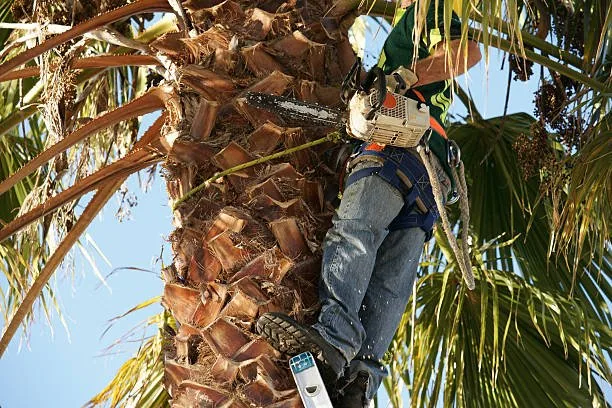
Palms catch people out. There is no branching structure to climb through and no taper to work with — just a single fibrous trunk carrying an enormous crown of fronds right at the top. Cut that crown badly and the entire load shifts at once, in a direction nobody planned for.
They also cannot be sectioned the way a hardwood can. The trunk has no heartwood to hold a hinge, so the usual felling cuts behave differently, and a phoenix palm adds spines that will go straight through a glove. Our team rigs the crown off first where the tree is close to a house or a boundary, then takes the trunk down in lifts that can be controlled all the way to the ground.
Queen palms, bangalow, phoenix and nikau all behave differently, and nikau in particular are often better retained than felled. If you are dealing with the root ball as well as the trunk, our palm tree removal page covers the grinding and site-reinstatement side in more detail.
Not every tree can simply be cut down because it is on your land. Auckland Council protects notable and scheduled trees, along with vegetation in Significant Ecological Areas, and kauri carry their own rules. Taking a protected tree down without consent is an expensive mistake, and it is the property owner who wears it, not the contractor.
We will flag it during the quote if we think your tree falls into one of these categories, and point you at what the council will want to see. You should still confirm the current rules with Auckland Council for your specific address before work is booked in.
The other conversation worth having early is with the neighbours. If a tree sits on a boundary, or the only sensible drop zone is over their lawn, a quick heads-up before the crew arrives saves a lot of awkwardness. We are happy to work to an agreed access arrangement where that is what the job needs.
Send us a photo or let us come and look. You will get an honest view on whether the tree really needs to go, and a written price if it does.