
1. Site assessment
We work out which species you have, how far the rhizomes have travelled, and what is in the way — fences, services, retaining walls, paving and the neighbour’s boundary.
Bamboo is not a tree at all — it is a giant grass, and that is exactly why it is such a problem. A tree has one trunk and one root plate in a known location. Bamboo has an underground network of rhizomes that can run several metres out from where the canes appear, travelling under fences, paths and driveways before sending up new shoots somewhere you were not expecting.
The critical distinction is between running and clumping types. Clumping bamboo expands slowly outwards from a tight base and is comparatively manageable. Running bamboo — most of the Phyllostachys planted as screening around Auckland — sends out long lateral rhizomes and is the one that ends up in the neighbour's garden. The two need completely different approaches, which is why identifying what you actually have is the first thing we do.
The other reason it defeats people is that bamboo regenerates from stored energy in the rhizome. Cutting the canes off at ground level, repeatedly, over several seasons, can eventually starve it out. Most people give up long before that, and one growing season of neglect puts it straight back where it started.
The order matters. Skipping straight to the digger without scoping where the runners have gone is how a job ends up half-finished, and it is why so much bamboo gets removed twice.
We work out which species you have, how far the rhizomes have travelled, and what is in the way — fences, services, retaining walls, paving and the neighbour’s boundary.
The standing culms come down first and get chipped or bundled. This is the visible part of the job and the quickest, but on its own it achieves nothing lasting.
The main root plate is dug out with a machine where access allows, or by hand where it does not. This is where most of the labour on a bamboo job actually sits.
Rhizomes heading off under lawn, paths and fence lines are traced and lifted. Missing these is the single most common reason bamboo comes back.
Material is loaded out rather than heaped on site. A cut length of rhizome sitting in a compost pile will happily start a new stand.
The area is backfilled and levelled ready for turf, planting or paving, and we will flag anywhere worth watching over the following season.
A surprising share of the bamboo calls we take are not really about bamboo — they are about the fence line. Someone planted a screen twenty years ago, the rhizomes crossed the boundary, and now two households are looking at the same stand of canes from opposite sides with very different views about whose problem it is.
As a general position in New Zealand, you can cut back growth that crosses onto your property, and the material is technically the owner's. But bamboo makes that messy — cutting the canes on your side does nothing about the rhizomes already under your lawn, and excavating up to a boundary line can undermine a fence that is jointly owned. What starts as a gardening job becomes a conversation about who pays for the fence.
The version that works best is the one where both sides deal with it together, in a single job, from both sides of the line at once. We are happy to quote it that way, and to talk both parties through what is involved. For anything contested, get your own legal advice before committing — we can tell you what is physically possible, not who is liable.
On a residential section, bamboo removal is usually one stand along a fence or around a courtyard — a day or two of work, with the awkwardness coming from access rather than scale. Getting a machine into a back garden through a side gate is often the deciding factor in how the job gets priced.
Commercial sites are a different shape of problem. Body corporates and property managers tend to inherit bamboo that has been spreading unchecked through shared planting beds for years, and industrial and development sites often have whole boundaries of it to clear before anything else can happen. Those jobs get scoped as a single project, scheduled around the site's operating hours, and quoted with the disposal volume built in.
Either way the underlying method is the same, and so is the standard we hold it to. If you are clearing a site more broadly, our land clearing service covers scrub, regrowth and mixed vegetation alongside bamboo.
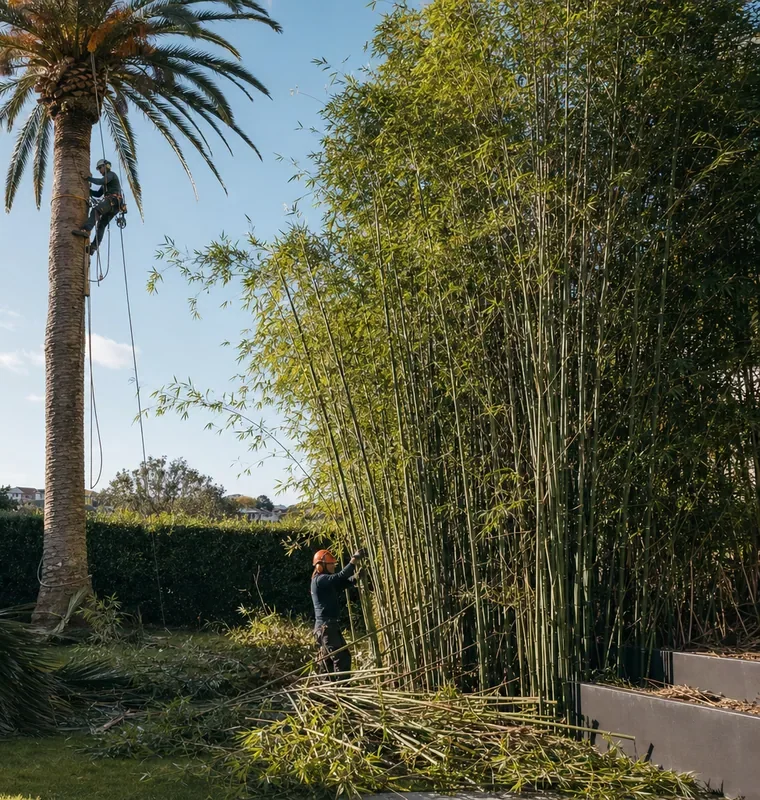
Bamboo looks like a job for a landscaper with a digger, and sometimes it is. The times it is not are the ones that get expensive.
Running and clumping bamboo need completely different treatment. Getting the species wrong means either wasted excavation or a job that fails within a year.
Knowing when a digger will reach and when it will damage a driveway, a drain or a retaining wall — and having the gear to do it by hand when that is the answer.
Bamboo loves growing tight against fences, foundations and drainage runs. Excavating around those without breaking something takes experience, not enthusiasm.
Public liability cover in place before anyone starts digging, which matters on a job that involves machinery close to boundaries and buried services.
If bamboo is spreading where you do not want it, the longer it runs the more there is to dig out. Book a free assessment and we will tell you what is actually under there.